Accurate diagram
This diagram is a much more faithful representation on what's going on that what's in the lattice docs.
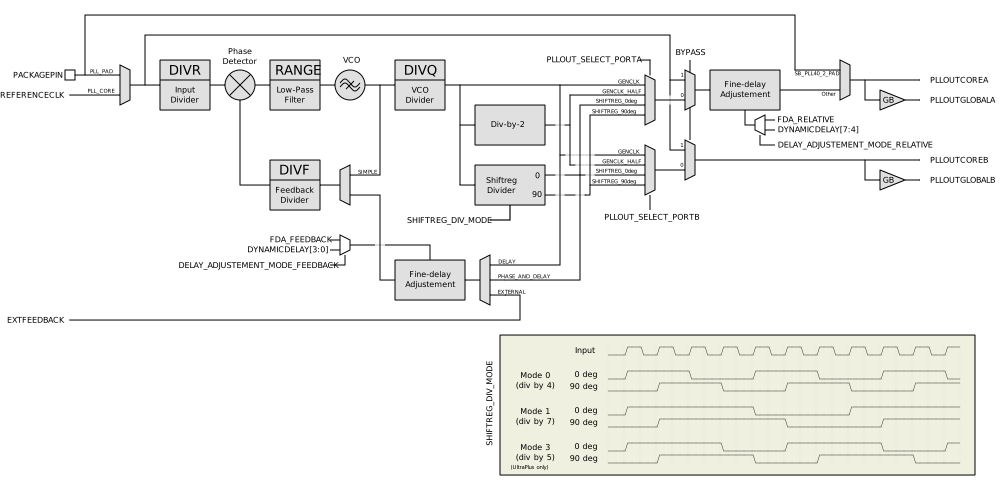
Dynamic reconfiguration
The iCE40 PLL has a dynamic reconfiguration port.
It can be enabled by setting the TEST_MODE parameter on the PLL instance.
Note that when doing so, the static configuration is ignored and you HAVE TO use the dynamic reconfig port to load a valid config for the PLL to do anything !
It's using 3 signals + the reset signal on the PLL :
output wire SDO,
input  wire SDI,
input  wire SCLK,
input  wire RESETB,
And this is basically a shift register that allows you to change the internal configuration of the PLL by shifting it a new one. This must be done while the PLL is in reset (and so you can't depends on its output to be running to shift in the new config !), and the new configuration will become active once reset is released.
Sequence would be :
- Assert the reset of your logic clocked by any PLL output
- Assert
RESETB(set to 0) - Shift in new config word 1 bit at a time, MSB first. Data is shifted in on the falling edge of
SCLK - Release
RESETB - Wait for
PLL_LOCK - Release the reset of your logic clocked by PLL output
The configuration word is 26 bits, or 27 bits for the UP5k :
[   26] ShiftReg[1]  (UP5k only)
[   25] FSEnet
[24:23] pllout1Sel
[   22] Source Clock (0=Pad, 1=Fabric)
[   21] ShiftReg[0]
[20:19] pllout2Sel
[18:17] delaymuxsel
[16:14] FILTER_RANGE
[13:11] DIVQ
[10: 4] DIVF
[ 3: 0] DIVR
FSEnetis the mux right beforeDIVFin the diagram above. Set to1forSIMPLEdelaymuxselis the feedback mux0:DELAY1:PHASE_AND_DELAY3:EXTERNAL
pllout1Selandpllout2Selare the output muxes0:SHIFTREG_0deg1:SHIFTREG_90deg2:GENCLK3:GENCLK_HALF